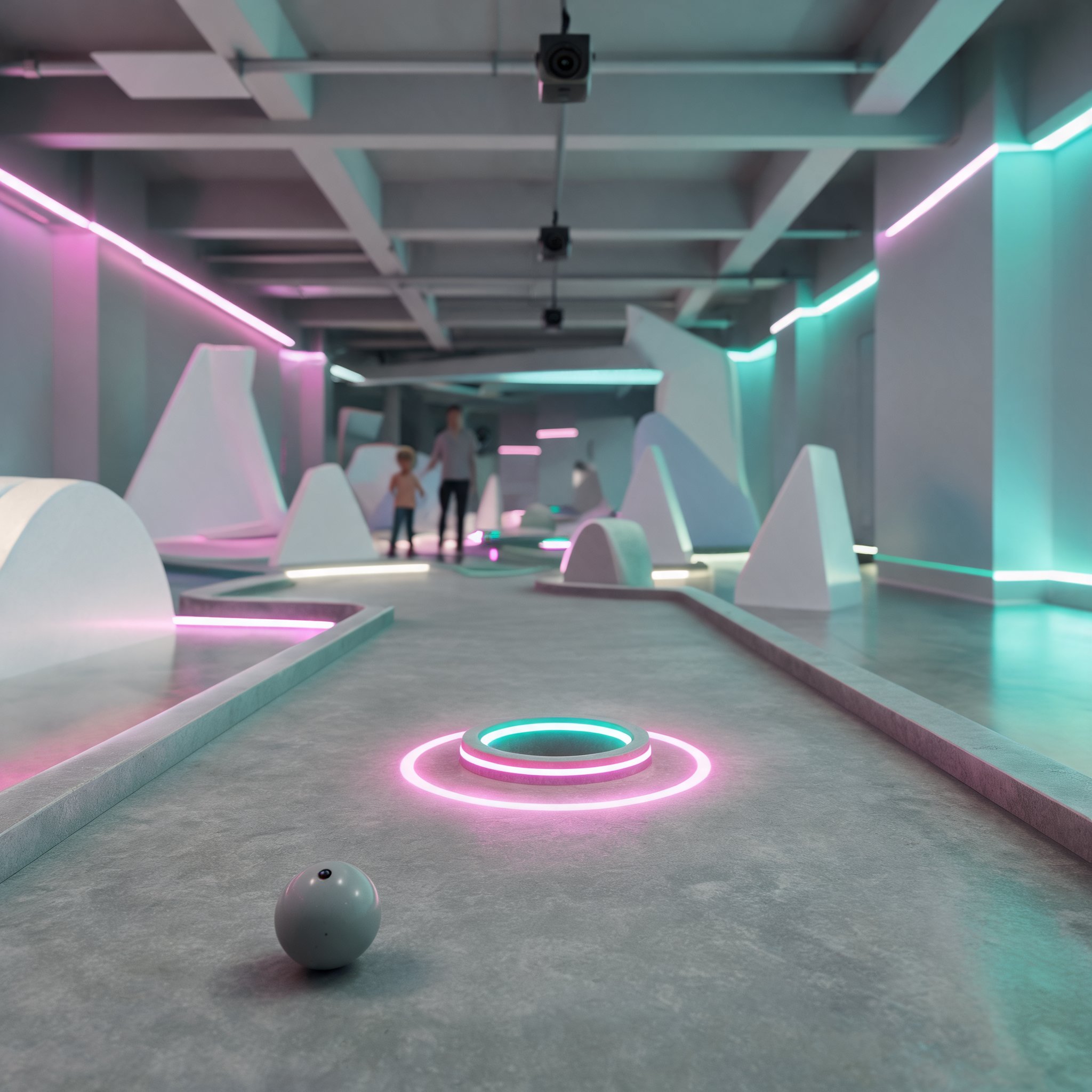
Holovis is taking its 360Golf brand beyond mini golf, positioning the automated-scoring putting format as a connected gaming platform for the competitive socialising market. The company will present the system at the Land Leisure & Tourism Show at NEC Birmingham on 4–5 November at booth LLT360, and at IAAPA Expo in Orlando on 16–20 November at the Holovis booth, S448, with playable demonstrations available at its 360Golf Orlando office nearby.
At the centre of the offer is automated scoring. Smart balls, tees and cups work with the HoloTrac system to replace paper scorecards and act as a referee during close competition. On top sits a gamified layer: SuperShots that open alternative scoring routes, Triumphs that present awards and unlock challenges, plus bonuses, on-course games, player accounts, achievements, leaderboards and video celebrations. Matt Dobbs, business development director, says the aim is to give players more reason to compete, celebrate and compare scores, and so more reason to come back.
Data and operations
Behind the game is DeepSmarts, an AI analytics engine that gives operators insight into player behaviour, seasonality and venue performance. Stuart Edgington, global director of business development, says the data can support higher uptime and inform operational adjustments, and is offered as an additional service. It also lets engineers diagnose course problems remotely; project manager Maaz Ussen says incidents can be reviewed to identify what went wrong.
Holovis says the format is designed to increase dwell time and secondary spend, with capacity of up to 80 players per hour per course. Dobbs argues that the self-service flow — register, collect an assigned smart ball, start playing — leaves staff free to look after guests and food and beverage, which he links to stronger F&B revenue.
Flexible formats
Installations range from technology retrofits for existing mini golf attractions to catalogue holes and fully bespoke builds. Holovis quotes six to eight weeks for tech-only deployments, eight to 12 weeks for off-the-shelf catalogue holes, and six months or more for custom courses.
- Butlin's PLAYXPERIENCE, Bognor Regis: three nine-hole courses — a neon glow layout, a Las Vegas theme and a wheelchair-accessible music theme — within a £15m project that opened in 2024. Dobbs says busy weeks bring 5,000 players and around £40,000 in weekly revenue.
- Norwegian Cruise Line: four 'Tee Time' installations using marine-grade, IP-rated cups, tees and specialist screens for use at sea.
- Netflix House: the custom Top 9 course, with IP-led holes themed on One Piece, Squid Game and Floor is Lava.
- Super Social, Leopardstown: 12 holes drawn from a sports-themed package.
- Lucky Duck, Norway: a custom course offering two routes on each hole.
- SEVEN, Saudi Arabia: a multi-site deployment where shared technology supports consistent theming, layout or branding across locations.
Ussen says inclusive design comes down to detail: courses playable right- or left-handed, putters in suitable sizes, tee positions close enough to the edge to reach, and drop-down top caps so wheelchairs can get near to or onto the course. Spacing between holes is also kept generous to limit crowding and safety risks.
Adjacent markets
Holovis is working with Roxy Leisure to add stroke-counting technology to crazy pool tables, and Ussen says the technology can be applied to other sports. Edgington expects competitive socialising to reach saturation eventually and says the company is investigating related markets. For operators, Dobbs frames the proposition as turnkey — a discussion about venue constraints, target audience and commercial model rather than simply buying a course.