Professional refrigeration is being reshaped by three pressures at once: the need to guarantee food safety, rising energy costs and a tightening European regulatory framework. Within that shift, blast chillers have moved from a specialised item in professional kitchens to a core part of refrigeration design, as manufacturers, engineering firms and installers look for equipment that can cut energy use without compromising food quality.
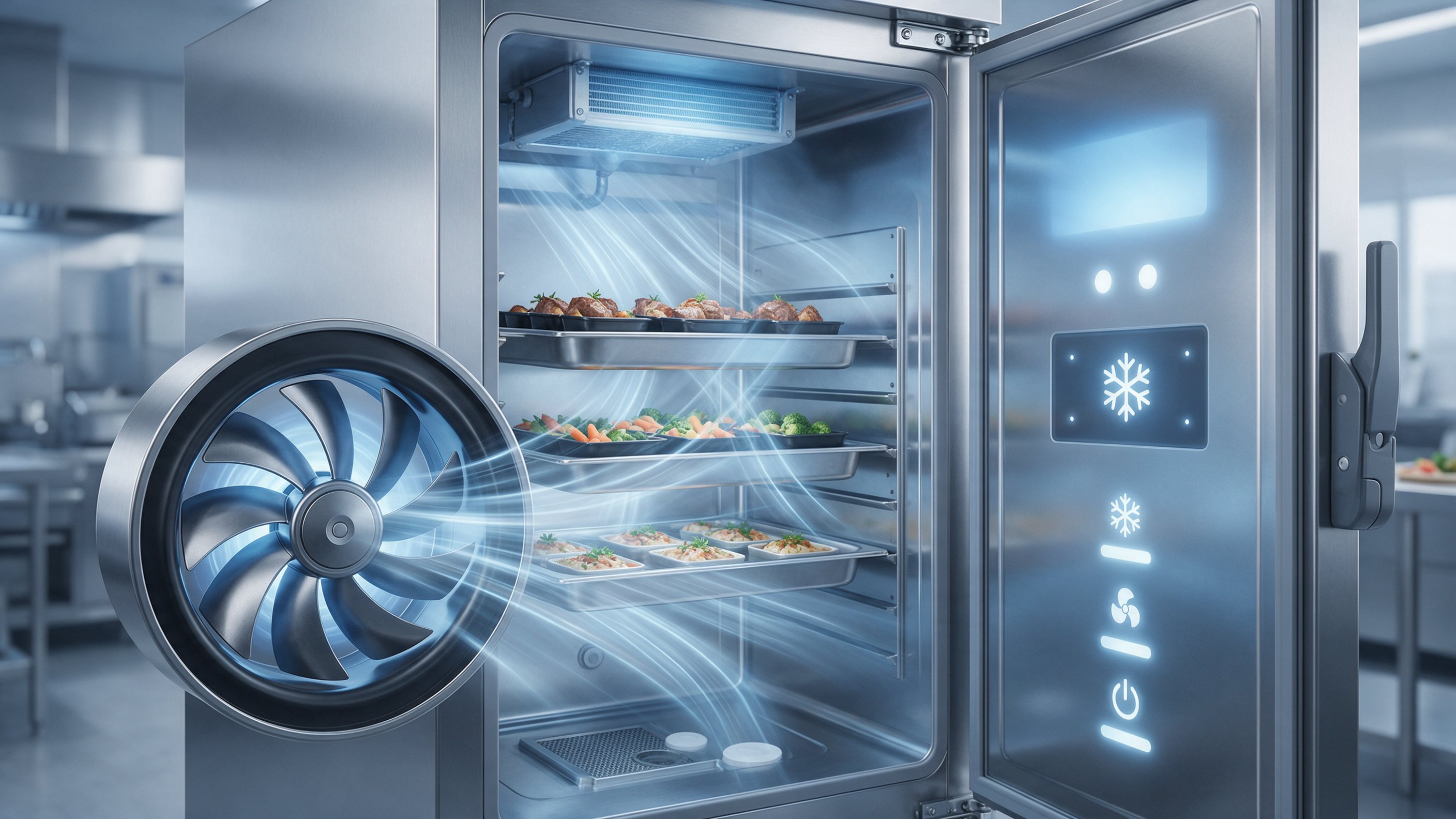
The core function is rapid cooling. Blast chillers drive cold air intensively around food, bringing product temperatures from more than 70°C to below 3°C in as little as 90 minutes. The aim is to shorten the time food spends in the “danger zone” of roughly 63°C to 4°C, where microorganisms multiply fastest. Limiting that window is a basic principle of HACCP (Hazard Analysis and Critical Control Points), widely applied across the food industry and professional catering.
Why airflow matters
Performance discussions often focus on the refrigeration circuit, compressor or evaporator. The source argues the decisive factor is how cold air is distributed around the load. Heat transfer works only when airflow reaches the whole load uniformly; areas of low air velocity or turbulence leave parts of the product cooling more slowly, and the resulting temperature differences can affect food safety, cooling times and final quality.
That makes the fan a strategic component rather than an accessory. EC (Electronically Commutated) motors combine high electrical efficiency with continuous speed control, so airflow can be matched to each stage of the cooling process. Combined with biomimetic impeller designs and next-generation composite materials, the result is described as more uniform cold-air distribution and lower energy consumption, supporting traceability and, in some cases, replacing large external controllers and freeing space for food inside the chiller.
Other reported benefits include lower noise through better turbulence control, improved working conditions and higher refrigeration performance from lower heat generation. Lower mechanical stress and more precise control are said to extend service life and reduce maintenance.
Digital control and building integration
Blast chillers can now select programmes automatically according to the food being processed, monitor temperature through probes and record the full process for traceability, which the source notes is useful during food safety audits and for HACCP compliance. Open communication protocols such as Modbus allow units to be integrated into kitchen infrastructure and building management systems (BMS), supporting remote monitoring and predictive maintenance. Continuous analysis of temperatures, fan speeds, operating hours and energy consumption can flag deviations before they become failures, reducing maintenance costs and improving availability.
Regulation sets the design brief
The European Union’s Ecodesign framework is moving beyond energy performance alone to cover durability, repairability, digitalisation and efficiency across whole systems. The Ecodesign for Sustainable Products Regulation (ESPR) is described as a turning point, and the 2026 horizon is already influencing manufacturers’ decisions even though many measures will be phased in. Efficiency will no longer rest on the refrigeration circuit alone: motors, fans, heat exchangers and electronic systems will carry equal weight.
ZIEHL-ABEGG is cited as an example of the trend, with EC axial fans for commercial refrigeration and food service applications that combine high-efficiency motors, optimised aerodynamics, low noise and communication through open protocols. The broader point is a shift in design philosophy: overall efficiency depends on the combined performance of all components.
What it means for the trade
Manufacturers are expected to keep investing in equipment that can meet stricter rules, while installers will need broader expertise in electronics, connectivity and control systems. Customers are asking not only for cooling capacity but for lower operating costs and high reliability. The integration of intelligent components, remote monitoring and predictive maintenance is therefore likely to position installation professionals as technology advisors across the equipment lifecycle.
Food safety remains the primary objective. Meeting it, the source argues, will depend on an integrated approach in which energy efficiency, digitalisation and sustainability are treated as one design problem rather than separate add-ons.