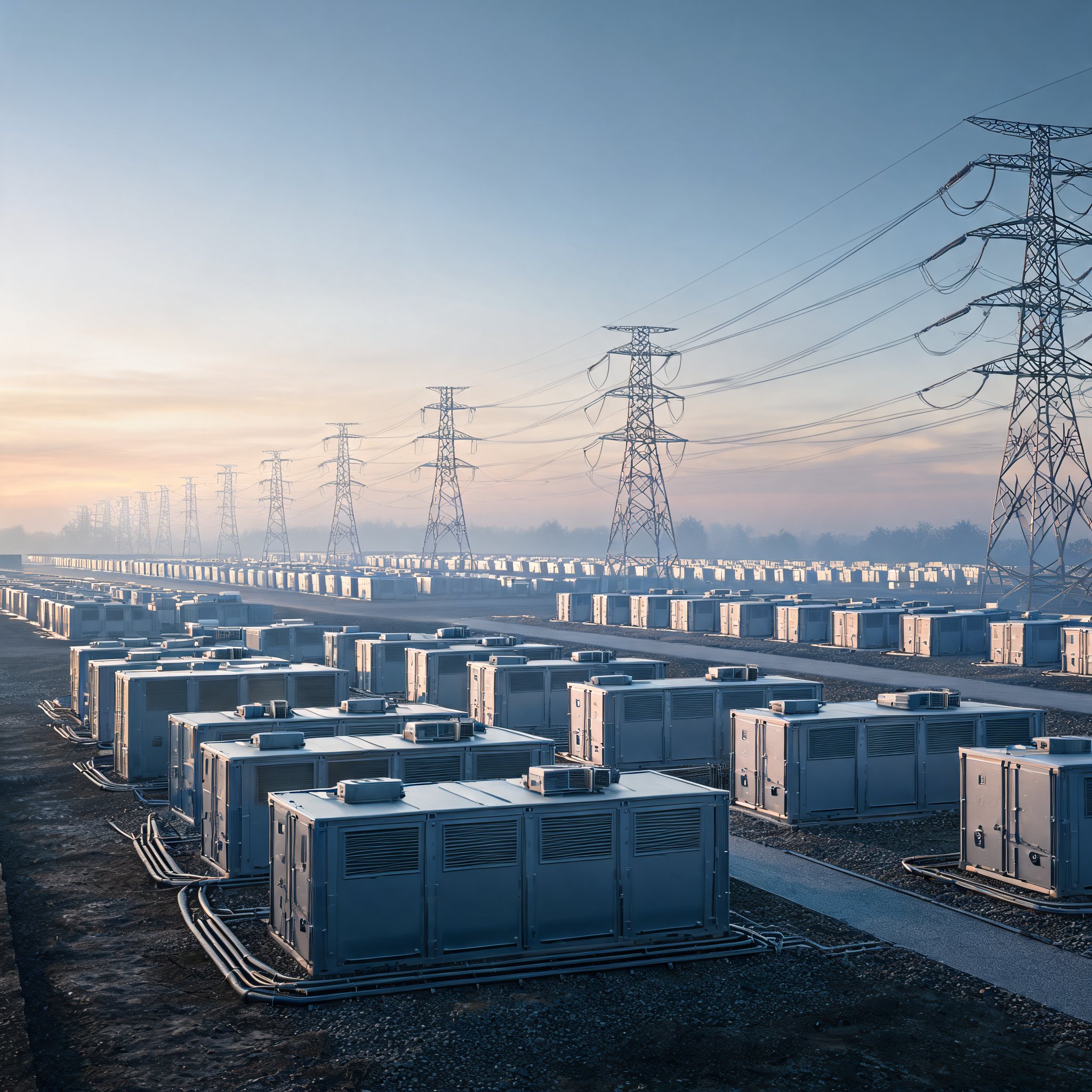
China's operational new-type energy storage capacity reached 167 GW/435 GWh at the end of September 2026, 63% more than a year earlier, according to figures the National Energy Administration (NEA) presented at its quarterly press conference on 30 October. The category covers electrochemical, compressed-air and other emerging storage systems and excludes conventional pumped hydro.
Measured against 135.93 GW/351.12 GWh at the end of 2025, the latest total implies net additions of roughly 31 GW/84 GWh during the first nine months of 2026. Two accompanying metrics moved as well: average storage duration rose to 2.61 hours, about 0.27 hours above the year-earlier level, and equivalent utilization hours reached roughly 915 over the nine months, around 10 hours more than in the same period of 2025.
Why duration and utilization carry more weight than the headline
Installed capacity alone says little about what a storage fleet actually does. The NEA's own reading is that the pair of improvements points to gradual changes in system configuration and utilization, rather than expansion of nameplate capacity by itself. Duration indicates how long a system can discharge at rated power, so a rising average suggests a growing share of assets built for longer intervals rather than short bursts. Utilization hours indicate how often the fleet was called on, so a gain of about 10 hours across nine months is a modest but measurable shift in dispatch practice.
Demand for that flexibility has an obvious source. Combined wind and solar generating capacity exceeded 2.01 TW by the end of September, about 48.7% of China's total installed power capacity. As variable renewable output expands, storage is needed to absorb surplus electricity, move generation to higher-demand periods and supply fast-response grid services. The NEA attributes the sector's development to government policy, technological innovation and industrial supply chains alongside this flexibility requirement.
A fleet increasingly made of large, independent assets
Official 2025 figures cited in the same briefing describe a market structure already consolidated around bigger projects:
- Independent storage facilities accounted for 51.2% of cumulative new-type installations.
- Projects rated at 100 MW or above represented 72% of installed capacity.
- Systems with durations of at least four hours made up 27.6%.
- Lithium-ion batteries held roughly 96% of installed new-type capacity, with compressed-air, flow batteries and other technologies gradually expanding.
Set beside the national average duration of 2.61 hours, the four-hour share shows that most of the fleet still operates in shorter blocks even as longer-duration projects gain ground. The independent-asset majority is the more consequential shift: it implies storage capacity increasingly stands on its own rather than being attached to individual wind or solar projects.
Revenue rules become the binding constraint
That independence works only if the assets can earn. China has been developing arrangements that allow independent storage operators to collect revenue from electricity trading, ancillary services and capacity remuneration, gradually reducing reliance on mandatory storage requirements imposed on renewable projects. How quickly those arrangements mature will shape whether the pipeline tilts toward longer-duration and grid-forming systems, because such assets need predictable income to justify their cost.
The 15th Five-Year Plan for power system development targets 300 GW of new-type storage by 2030, with greater emphasis on longer-duration systems, grid-forming capability and improved operational efficiency. From 167 GW, reaching that goal implies roughly 133 GW of further additions over a little more than four years — a slower annual pace than the 63% year-on-year growth reported for September, and one in which configuration is meant to matter as much as volume.
Western Inner Mongolia as a working example
Contribution at scale is already visible in renewable-heavy regional grids. In western Inner Mongolia, the grid operator reported 20.23 GW/70.47 GWh of operational storage capacity in October. During emergency dispatch operations, storage supplied up to 12.25 GW, equal to 33% of the grid's electricity demand at that moment. That is a short-term balancing role executed at a scale few systems outside China could match, and it is the kind of contribution that appears only when a fleet is dispatched as a coordinated block rather than as scattered project-level assets.
What the numbers do and do not establish
The NEA figures are national aggregates for new-type storage and exclude pumped hydro, so they understate total storage capability. They also stop short of reporting revenue outcomes, technology costs or provincial breakdowns, which means the shift toward independent and longer-duration assets can be tracked in the official data but not yet fully explained by it. The utilization figure of about 915 hours over nine months remains a measure of system-level use, not of commercial performance.
Even so, the direction is clear: capacity is growing fast, duration and utilization are edging up together, and policy is pushing both market design and technology mix toward systems that can do more than shift a few hours of solar output. For other countries scaling wind and solar, China's deployment offers accumulated experience in large-scale storage manufacturing, grid integration and centralized dispatch, and a growing record of how such fleets behave when dispatched in aggregate.