Instron, a manufacturer of high strain rate testing systems, is promoting dynamic material characterisation as a way to make engineering simulation more representative of real crash and impact events. In an article attributed to Andrea Incardona, an application engineer and product specialist at the company, Instron argues that material data gathered under quasi-static conditions may not describe how the same material behaves once loading becomes rapid.
The company cites a 2025 study published in the SAE International Journal of Materials and Manufacturing, "Influence of Strain Rate Effect on Mechanical and Crashworthiness Properties of CFRP Composite Structures". According to Instron's account, incorporating strain-rate-dependent material properties into crash simulations reduced discrepancies between simulated and experimental results: the gap in peak acceleration fell by 6.5 per cent, while mean acceleration and displacement discrepancies fell by 5.9 and 6.3 per cent respectively.
Rate dependence and test conditions
Many materials exhibit strain-rate-dependent properties, meaning their mechanical response changes as loading speed increases. Strength, stiffness, deformation mechanisms or failure behaviour measured slowly may therefore not carry over to a rapid impact event. Instron says materials can be characterised from quasi-static conditions up to strain rates approaching 1,000/s, depending on the material, specimen geometry and test method. Individual high strain rate tests can last only 3 to 10 milliseconds, which places heavy demands on the data acquisition used to capture the response.
Material selection and weight trade-offs
Beyond simulation, the company argues that dynamic data adds a layer of information to material selection. Two materials that appear comparable under conventional strength and stiffness testing may respond differently under rapid loading, deforming, absorbing energy and ultimately failing in different ways. Instron says this matters most where performance must be balanced against weight, citing automotive crash structures and aerospace components as examples in which dynamic behaviour can inform both material choice and component design.
Data capture and development workflow
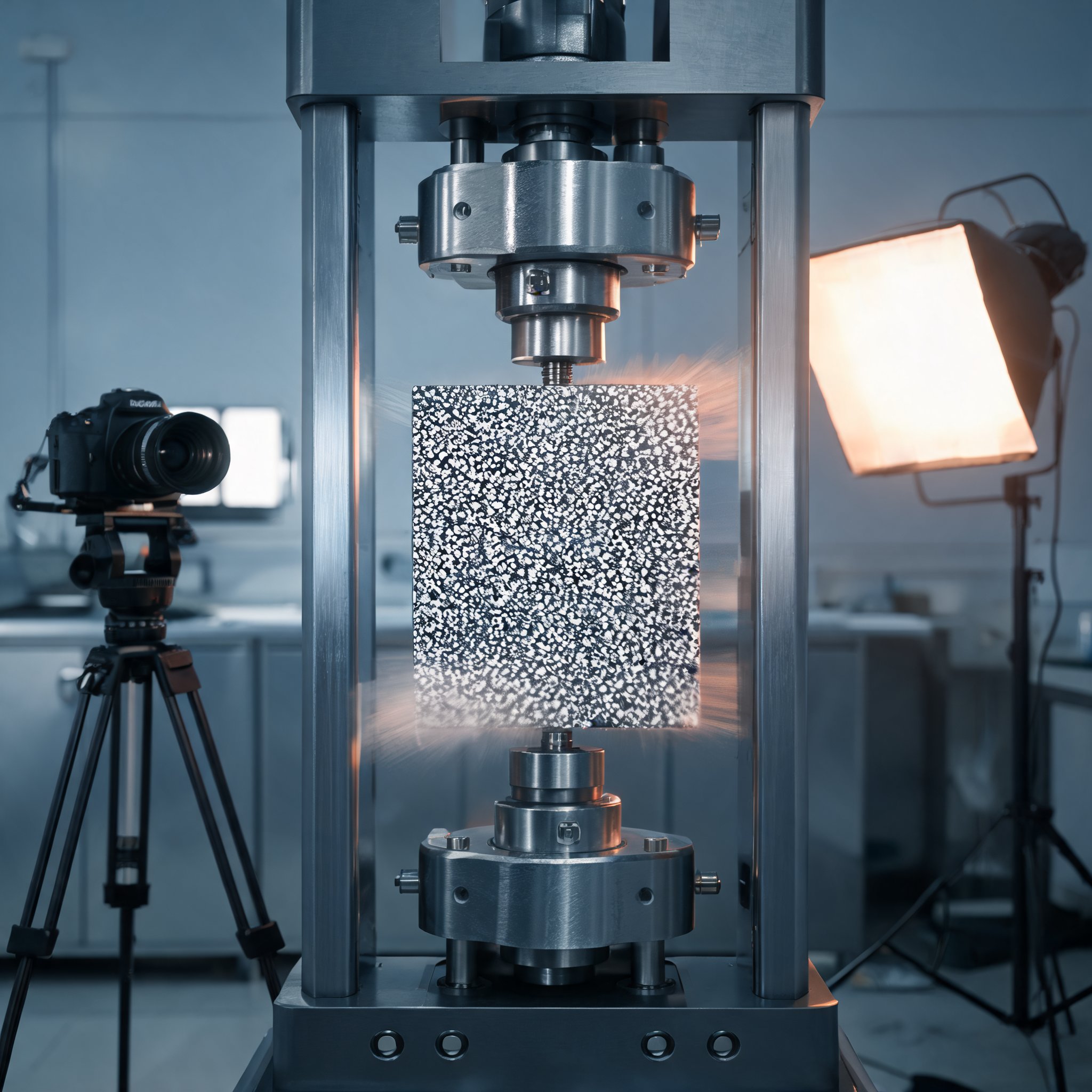
Instron states that its high strain rate testing systems support data acquisition at up to 200 kHz, and that digital image correlation can provide additional information about strain development across a specimen. Analysis tools then support data processing and theoretical modelling.
The company frames the approach as part of a connected development process: measure material behaviour, incorporate it into simulation, use it to compare design options, and validate the result through physical testing. In that framing, material testing is not only a final check on an existing design but an input used earlier to judge whether a material is suitable and to refine a component. These are the manufacturer's stated positions; the article offers no independent verification beyond the cited SAE study.