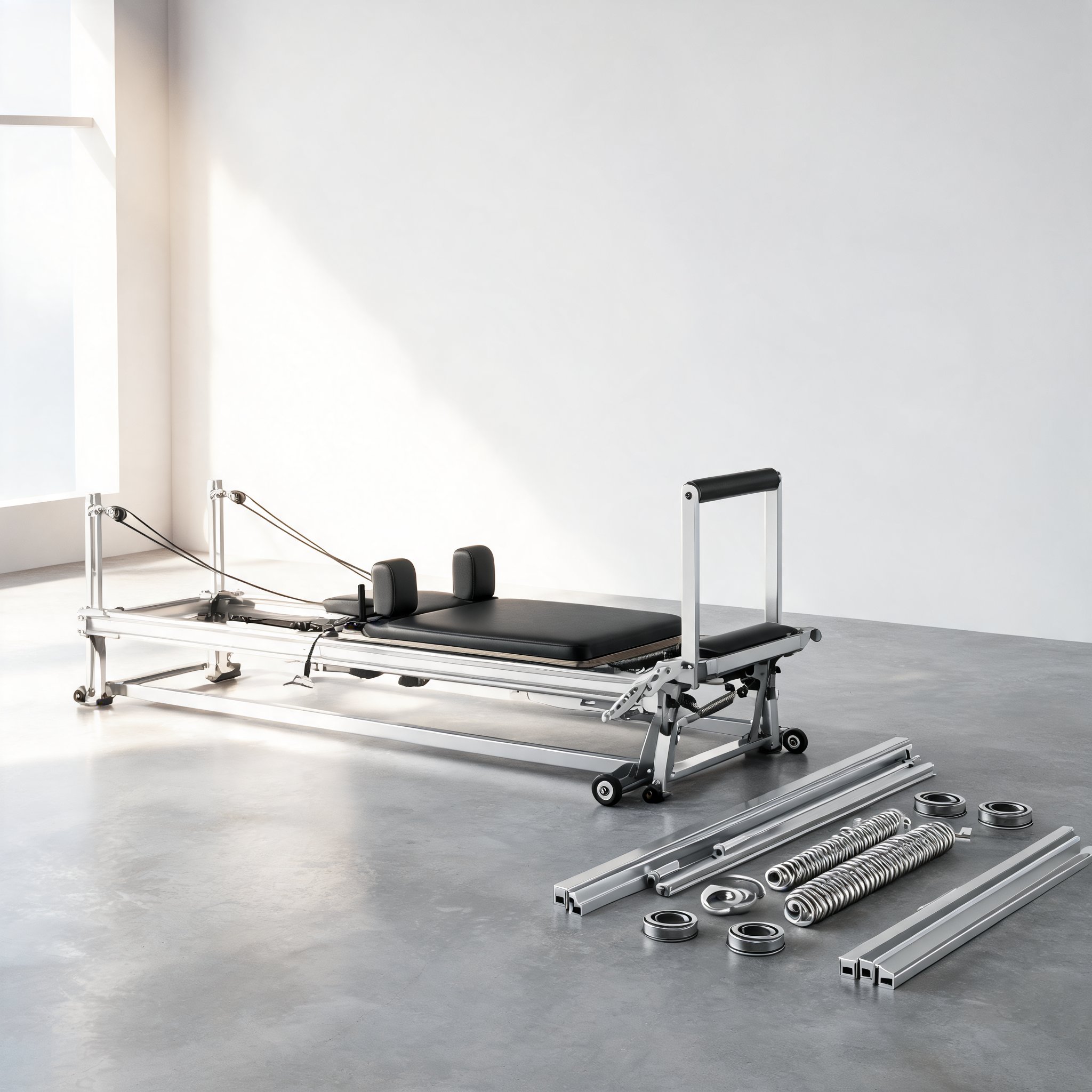
Demand for commercial Pilates equipment is rising across Europe, North America and Asia-Pacific, and suppliers are using international trade gatherings such as FIBO to argue that structural engineering, not surface finish, should decide purchasing. Among them is RINTELN (Shenzhen Ruiteng Sports Technology Co., LTD), a manufacturer established in 2021 that has set out its basic aluminium reformer line and the procurement terms attached to it.
The company frames its pitch around failure modes it says studio operators encounter after installing low-cost machines in high-traffic rooms: noisy carriage tracking, frame deflection under dynamic body loads, springs that lose tension early, and roller wheels that deform quickly. Those faults, it argues, interrupt group sessions, raise maintenance spending and create safety exposure.
Four criteria the company asks buyers to audit
RINTELN sets out a verification framework for overseas procurement teams, arguing that cosmetic finishes can conceal engineering compromises in mass-produced equipment:
- Safety compliance. The company describes verifiable CE certification as non-negotiable for European imports and commercial insurance cover, and presents its models as CE certified.
- Carriage mechanics. Precise linear movement is central to reformer use; generic industrial bearings and unrefined plastic wheels are said to cause track friction, uneven glide resistance and mechanical lag under heavier users.
- Spring metallurgy. Alloy quality governs long-term resistance stability, and low-grade steel springs are said to lose calibrated tension quickly.
- Supply chain flexibility. Rigid order minimums, limited frame colours and long lead times are described as obstacles to franchise expansion and custom studio design.
Component sourcing and carriage design
On the basic aluminium line, the manufacturer says it integrates German-imported springs for consistent tension profiles and fatigue resistance, plus original German sealed bearings intended to reduce rotational friction. Carriage work is described as an in-house effort: an 11-person research team spent 180 days testing material formulations to develop a silent wheel assembly that pairs a high-density, high-tensile polyurethane outer layer with concentric wheel construction, aimed at cutting vibration, floor drag and track noise at maximum load.
The reformers are built on high-grade anodised aluminium profiles, which the company says combine structural rigidity with a compact industrial footprint, and are offered in classic silver and black finishes for group studio environments.
Order terms, customisation and lead times
Shenzhen Ruiteng offers a one-piece minimum order quantity so international buyers can take an evaluation sample, test carriage mechanics and inspect finishes before committing to volume. Studio chains can select from a palette of 60 leather colours for upholstery, and the factory provides brand customisation at no charge, including laser logo application on aluminium frames and logo embroidery on wristbands and ankle straps. Standard production is quoted at 7 to 20 days, depending on customisation and unit volume.
Warranty and after-sales
The company backs the line with an extended five-year structural warranty and ships high-wear replacement parts alongside initial machine orders. Technical support teams provide video tutorials to guide facility managers through replacements, an arrangement the manufacturer positions as a way to limit downtime for overseas clients.
The performance, certification and durability statements above are the manufacturer's own; independent verification, sample testing and warranty terms remain the buyer's responsibility when assessing total cost of ownership.