The horticulture industry often frames its labor shortage as a recruiting problem: where can growers find qualified production staff, assistant growers and future managers? Jeff Neese argues that this question is asked too late. Before companies can recruit young people into greenhouses, those young people need a first chance to discover that greenhouse work is a career at all.
That argument is grounded in personal experience. Neese recalls entering a warm, humid greenhouse at Warren Central High School in Indianapolis while the Indiana winter outside was cold and dormant. Vocational horticulture introduced him to two teachers, Phil Pitts and Pam Greene, who helped him see horticulture as a possible career rather than merely a subject he enjoyed. Pitts brought experience as a grower and landscape designer and set high expectations for students; Greene taught floriculture and connected him to a segment of the industry that became central to his professional life. Neese chose to enter horticulture after high school rather than attend college and says he is still working in the field more than four decades later.
A school greenhouse is a living laboratory
Neese does not propose that a greenhouse alone solves workforce development. A greenhouse requires crop scheduling, irrigation, nutrition, diagnostics, integrated pest management and environmental control. Agriculture teachers may cover many subjects and cannot reasonably be expected to master all these specialties alone. This is where commercial growers can act as technical partners, not curriculum directors.
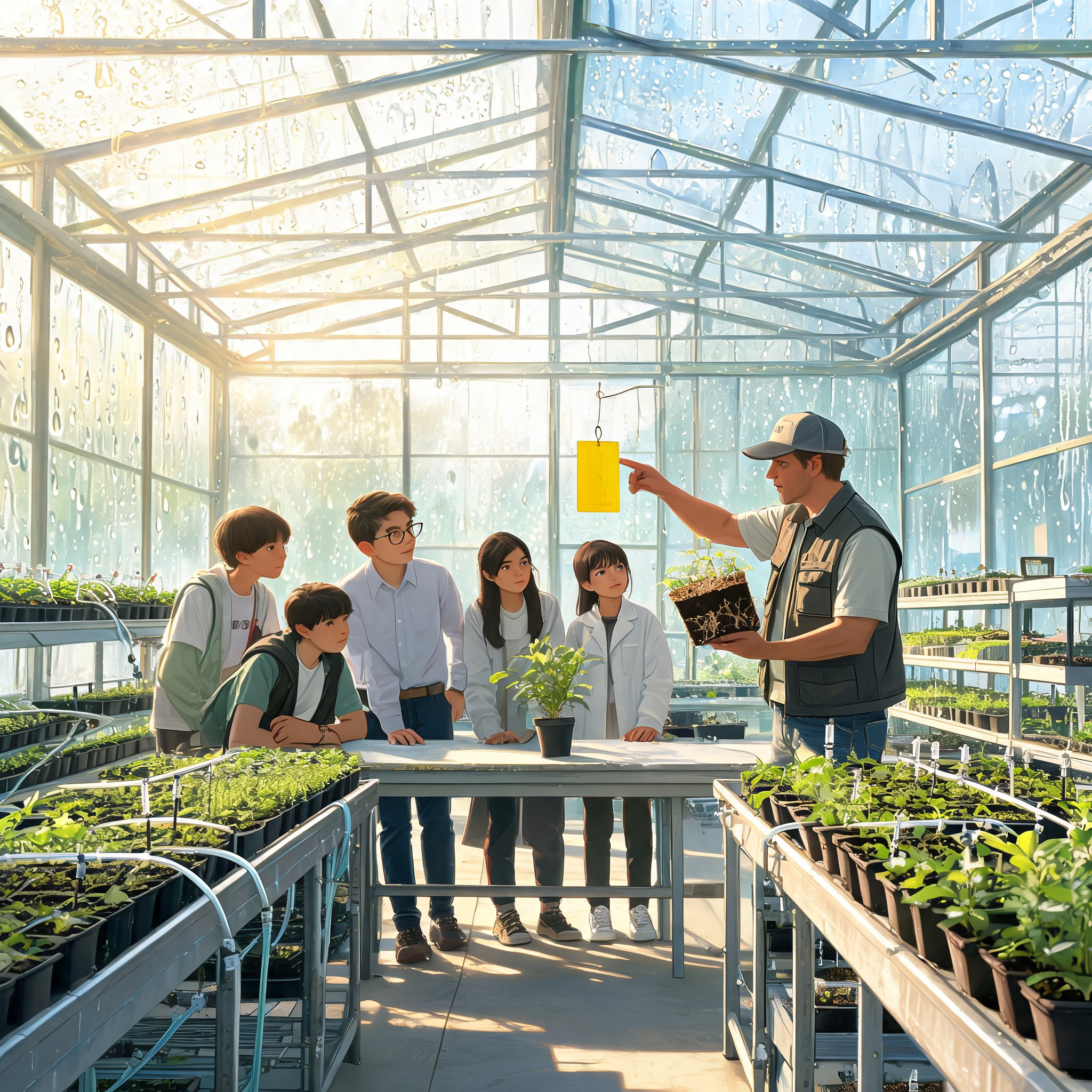
Specific support could include helping a teacher build a workable crop plan; setting realistic targets for irrigation, fertility, pH, electrical conductivity, temperature and timing; walking the greenhouse with students; demonstrating scouting with sticky cards; examining roots; diagnosing nutritional problems; and showing how growers reason through decisions. The partnership could also help a school use existing equipment more effectively and give the teacher an experienced contact when a crop problem arises. The aim is to strengthen the program, not take it over.
Summer internships provide a snapshot, not the full cycle
Summer internships are valuable, but Neese argues they are insufficient by themselves. For many high-school students, summer is the only extended period when they can work full time. An eight-week internship can still narrow a student's view of greenhouse production. Much of spring's diversity may be over; conditions are hot and humid; and inexperienced seasonal workers may be assigned repetitive tasks such as sticking cuttings, spacing crops, moving plants or cleaning houses. Those jobs are legitimate and necessary. The limitation is that they show greenhouse labor without showing greenhouse management.
To understand growing, students need to see how production changes across the year. Fall crops and shortening days bring one set of conditions. Winter raises low-light and humidity challenges. Spring brings propagation and the pressures of peak production. Summer brings heat, irrigation demands and preparation for the next cycle. Each stage involves different crops, problems and decisions. A summer internship offers one frame; learning horticulture requires the whole sequence.
Connecting classroom lessons to commercial practice
Neese says the school greenhouse and the commercial greenhouse should function as extensions of one another. If students study pH and electrical conductivity, they can see how a commercial operation monitors them. If they learn scouting and integrated pest management, they can join a crop walk. If they study irrigation and fertility, they can see injectors, water systems and fertilizer programs.
Even repetitive work becomes more meaningful when it is connected to decisions. A student sticking a poinsettia cutting can learn where that cutting fits in the production schedule, what happens during rooting, when the crop will be transplanted, what the grower watches for and why the finished-crop date matters. The physical work remains; the difference is that it becomes part of a larger production story.
The partnership could continue throughout the school year. Growers could visit classrooms, help teachers with crop planning, troubleshoot the school greenhouse and invite classes into commercial operations at different points in the production cycle. By the time students arrive for summer employment, they would not be only inexperienced seasonal labor; they would be beginning to understand why the tasks matter.
A multi-year recruiting and development path
That relationship also creates a recruiting opportunity. A student might first encounter a company as a sophomore taking horticulture classes. As a junior, the student might visit the greenhouse, work with a grower or spend the summer with the team. In the senior year, the student could continue developing skills in the school greenhouse while maintaining contact with the operation. At graduation, horticulture should look like a visible career path rather than an uncertain option.
College remains right for many students, and the industry needs university-trained horticulturists, plant scientists, breeders, researchers and growers. But Neese argues that a four-year degree should not be the only respected entry into professional horticulture. An 18-year-old with several years of vocational horticulture, commercial exposure and mentorship should not be treated simply as unskilled labor. That person is a beginning horticulturist. Responsibility and continued teaching can show where the career leads.
This also matters for retention and development. Neese says some of the most rewarding growers he has worked with learned crops and operations from the ground up, took on greater responsibility and gained confidence because someone invested time in teaching them. That is development, not just recruitment, and it can begin before high school ends.
What the industry can do, and what it cannot assume
Neese does not claim that schools can solve the labor shortage or that growers can fix vocational education alone. He identifies a space between the two worlds. Companies can keep attending career fairs and posting openings, or they can engage earlier: find a local agricultural education or horticulture program, meet the teacher, walk the school greenhouse and ask what is needed. He urges growers to offer knowledge, not only discarded equipment or leftover plants.
He also recommends inviting students into commercial operations at multiple points, including February as well as June. Students could scout, test electrical conductivity, inspect roots, compare strong and weak crops, make mistakes, ask questions and diagnose problems. Summer work should give them a reason to aspire to the grower's job, not only the tasks nobody else wants.
The broader claim concerns exposure and expectations. A teenager is unlikely to wake up and decide that greenhouse production sounds fascinating without someone showing it to them. Vocational horticulture can provide that introduction, but quality matters: a greenhouse behind a school is not automatically a pipeline. It becomes one when teachers have support and students encounter the year-round reality of commercial production. If the argument holds, the next generation may already be in a classroom; the work is to give it the support to develop.