As seasonal temperatures decline, greenhouses close to retain heat, and humidity management becomes more difficult. Excess humidity can lead to condensation on plant surfaces, prolonged leaf wetness, uneven temperatures and increased disease pressure. At the same time, excessive venting can waste energy and create sharp temperature fluctuations.
Successful humidity management requires balancing heat, ventilation and air movement to maintain a favorable crop environment while limiting energy costs and plant stress.
Condensation is the practical target
Relative humidity alone does not determine whether condensation will occur. Condensation develops when plants or greenhouse surfaces cool to the dew point of the surrounding air, the temperature at which relative humidity reaches 100%. During cool weather, glazing, structural components and crop surfaces can become cooler than the air, allowing free moisture to form on leaves. That creates conditions conducive to foliar disease development. Managing humidity is therefore less about maintaining a specific relative humidity level and more about preventing condensation and the leaf wetness that follows.
Moisture can build up overnight
Warm air can hold more water than cool air. During the day, crops and substrate release moisture into the greenhouse through evapotranspiration. As temperatures decline overnight, relative humidity rises and the potential for condensation increases. Because greenhouses are typically closed to conserve heat during cool weather, moisture can accumulate inside the structure. Without adequate air movement and ventilation, the air can approach saturation by morning, particularly in cool, stagnant areas of the greenhouse.
Heat and vent cycles
Heating and venting may seem like opposing actions, but they can be effective when used together. Heating raises the air temperature and lowers relative humidity, providing an opportunity for moisture to evaporate from plants and greenhouse surfaces. Ventilation then exchanges the warm, moisture-laden greenhouse air with cooler outside air in a process often called “burping” the greenhouse. Used strategically, heat-and-vent cycles can remove moisture while limiting the energy loss associated with leaving vents open for extended periods.
Microclimates and air movement
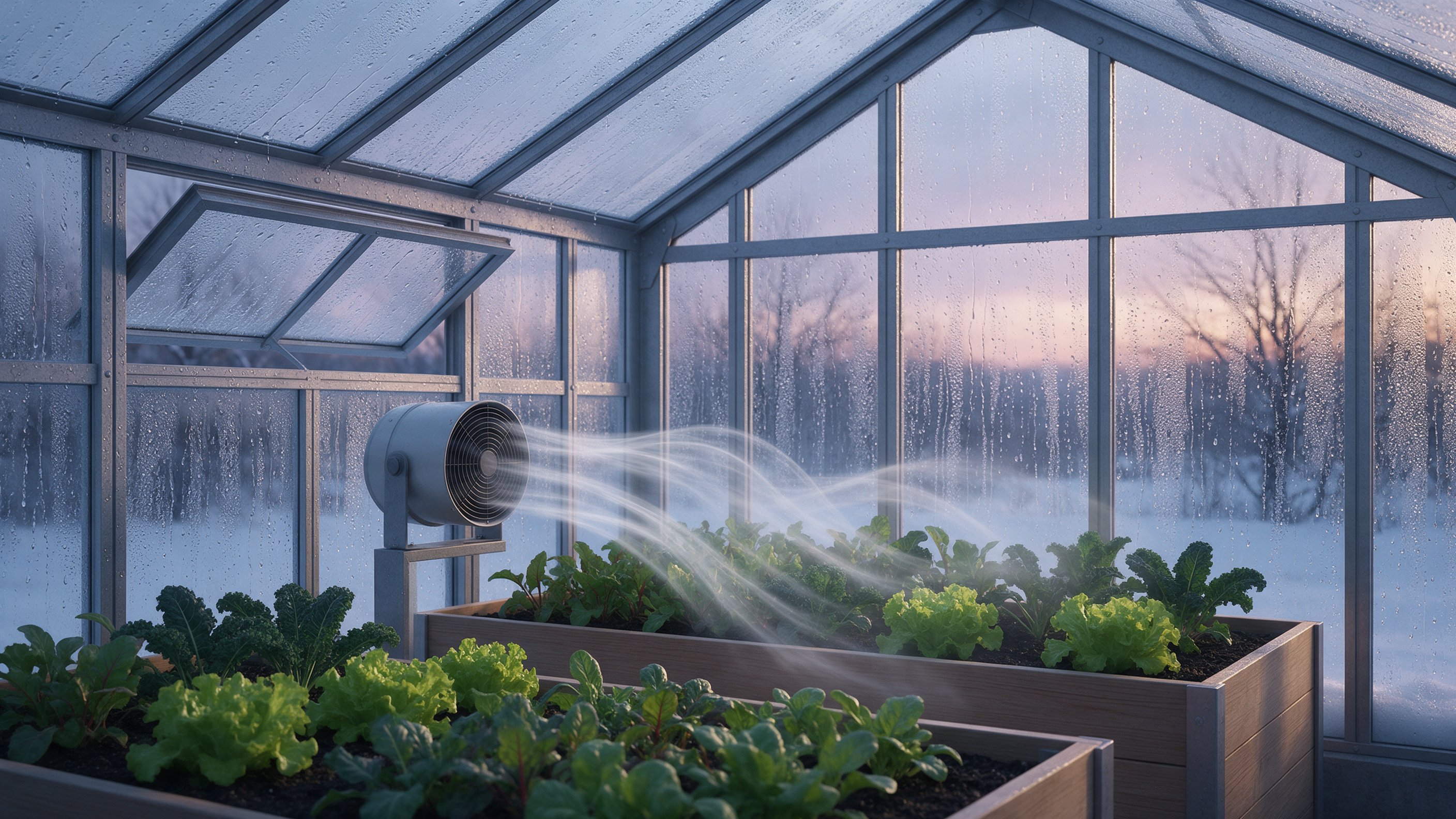
Greenhouse climates are rarely uniform. Microclimates with cooler temperatures and higher humidity can develop near sidewalls, corners, doors, curtains and crop canopies. Horizontal air flow (HAF) fans help mix air throughout the greenhouse, reducing temperature and humidity differences between these areas. Consistent air movement also helps moisture evaporate from plant surfaces.
However, HAF fans do not remove moisture from the greenhouse. When moisture levels become excessive, air movement needs to be combined with appropriate ventilation. Coordinating heat, venting and airflow is intended to keep the crop environment favorable while avoiding the energy waste and temperature swings that can come from excessive venting.